
Snow Removal Equipment Explained: What Works Best and Where
Snow removal can involve everything from a basic shovel to equipment capable of clearing an entire commercial parking lot. The right tool depends on the amount and type of snow, the size of the area, available space and the surface being cleared.
In Regina, there’s another consideration: wind. Snow that was light and easy to move when it first fell can become drifted, packed or considerably more difficult to clear later.
Understanding what different snow-removal equipment actually does can help explain why one method may work well for a residential walkway but make little sense for a large parking area.
Snow Shovels
The ordinary snow shovel remains one of the most useful winter tools.
Shovels provide precise control and can reach areas that larger equipment cannot. They’re particularly useful for:
- Steps
- Porches
- Narrow walkways
- Areas close to doors
- Small driveways
- Tight spaces around buildings
The main limitation is physical effort. The deeper, heavier or more compacted the snow becomes, the more demanding hand shovelling can be.
Shovelling is often most effective when snow is cleared before it becomes heavily packed or drifted.
Snow Pushers
A snow pusher looks similar to a wide shovel but is designed primarily to push snow rather than lift and throw it.
On relatively flat surfaces, a pusher can move light snow efficiently with less lifting.
They’re useful for areas such as sidewalks, decks and some driveways, but become less effective when snow is deep, heavily packed or needs to be moved over a significant distance.
Snowblowers
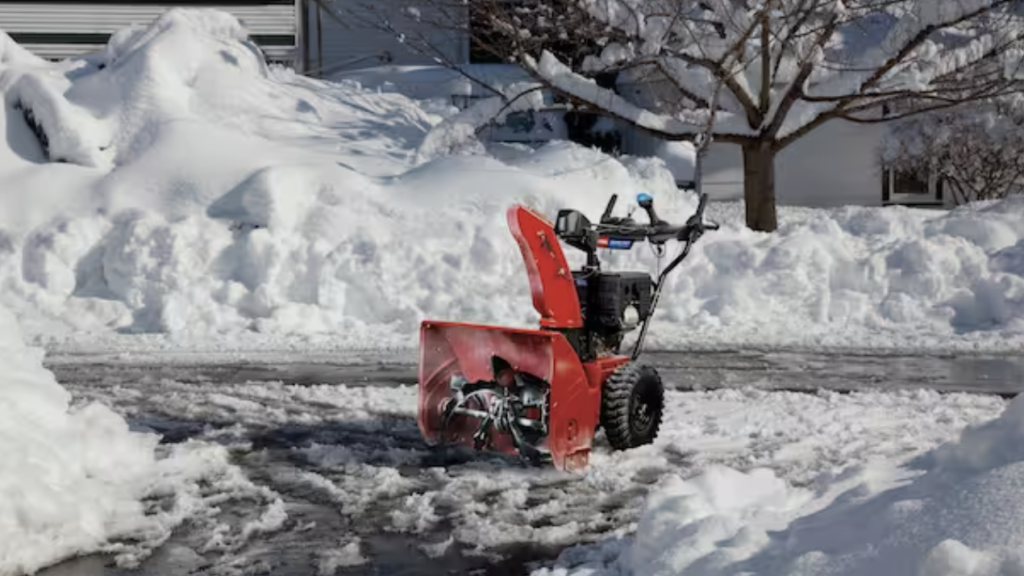
Snowblowers collect snow and discharge it through a chute, allowing snow to be moved farther away from the area being cleared.
They come in different sizes and designs, ranging from smaller machines intended for relatively light residential use to larger models designed for deeper or more difficult snow.
A snowblower can be particularly useful when:
- A driveway is too large to shovel comfortably
- Snow needs to be moved away from the clearing area
- Snowbanks are beginning to reduce available storage space
- Repeated winter clearing is required
Snow placement still matters. A snowblower needs somewhere appropriate to discharge the snow, and wind direction can make the job easier—or send blowing snow back toward the person operating the machine.
Snow Plows
A plow moves snow by pushing it across a surface rather than throwing it.
Plows can be mounted on trucks, utility vehicles and other equipment. They’re well suited to larger open surfaces where snow can be pushed toward an appropriate storage area.
Typical applications include:
- Larger driveways
- Parking lots
- Commercial properties
- Private roads
- Large open paved areas
Space is important. A plow doesn’t make the snow disappear—it relocates it.
As snowbanks grow throughout the winter, planning where additional snow can be placed becomes increasingly important.
Skid Steers
Skid steers are compact, highly manoeuvrable machines commonly used for many types of property and construction work.
For snow removal, they can be fitted with different attachments such as buckets, blades and snow pushers.
Their manoeuvrability can make them useful in areas where larger equipment would be difficult to operate.
Depending on the attachment, a skid steer can push, collect or relocate snow rather than simply moving it to the edge of a clearing area.
Front-End Loaders
For large properties or significant snow accumulation, loaders can do something smaller equipment often cannot: pick up substantial amounts of snow and relocate it.
This becomes important when snowbanks have grown so large that simply pushing more snow to the perimeter is no longer practical.
Loaders are more commonly associated with:
- Large commercial properties
- Parking lots
- Industrial sites
- Large snow-storage areas
- Snow relocation or loading operations
For an ordinary residential driveway, this type of equipment would usually be unnecessary.
Sweepers and Power Brooms
Rotating power brooms or sweepers can remove relatively light snow from paved surfaces.
Rather than pushing a large accumulation, they sweep snow away and can leave a cleaner surface under suitable conditions.
They may be useful around:
- Sidewalks
- Entrances
- Commercial walkways
- Other paved pedestrian areas
Their usefulness depends heavily on the type and depth of snow.
Ice-Control Spreaders
Snow removal and ice control are related, but they’re not the same job.
Spreaders are used to distribute materials such as salt, other de-icing products or traction materials across surfaces.
They range from small handheld or walk-behind units to larger vehicle-mounted spreaders used on commercial properties.
The appropriate material and application depend on factors including temperature, surface conditions and the purpose of the treatment.
Bigger Equipment Isn’t Always Better
It’s easy to assume that larger equipment automatically means better or faster snow removal.
That isn’t necessarily true.
A large machine may be efficient in an open parking lot but completely unsuitable for a narrow residential walkway. Smaller equipment may provide much better control around steps, buildings, landscaping and confined spaces.
The goal is to match the equipment to the property and the work that actually needs to be done.
The Type of Snow Matters Too
Not every snowfall produces the same clearing conditions.
Light, dry snow can behave very differently from wet snow, compacted snow or hard-packed drifting.
Conditions can also change after the snow falls. Vehicle traffic can compact snow, wind can create drifts, and changing temperatures can contribute to harder or icier surfaces.
That’s why equipment that works perfectly after one snowfall may not be the best choice after another.
Protecting the Property Matters
Regardless of the equipment being used, operators need to be aware of what’s underneath and around the snow.
Curbs, driveway edges, steps, landscaping, retaining walls, utility equipment and small objects can become difficult to see after snow accumulates.
Preparing a property before winter—including marking boundaries and removing potential obstacles—can make snow clearing easier and reduce the chance of accidental damage.
Choosing Equipment for the Job
There isn’t a single “best” piece of snow-removal equipment.
For a front step, the best tool may be a shovel.
For a residential driveway, it might be a shovel, snowblower or combination of methods.
For a large commercial parking lot, mechanized equipment may be much more practical.
And when accumulated snow needs to be physically relocated rather than simply pushed aside, an entirely different type of equipment may be required.
What matters is matching the equipment to the size of the property, the surface, available snow-storage space and the conditions at the time.
For more practical information about preparing driveways and walkways before winter, see our How to Prepare Your Driveway & Property for Snow Removal guide.
You can also explore our Regina Winter Resources for more information about snow, ice and winter property maintenance.